
Spinline runs a single cashier across every market it accepts, and Australia sits inside that list rather than on the operator’s restricted one. Australians get the same rails as everyone else, with the balance held in AU$ provided you choose that currency at sign-up. There is no PayID button, whatever a handful of comparison pages promise. What follows is the cashier as it stood on 3 September 2026: the eleven methods in it, the waiting time each one costs you, and the places where ordinary Australian banking habits run into an offshore, Curaçao-licensed casino. If you are still weighing the brand up rather than funding it, the Spinline Australia overview covers the licence, the library and the welcome terms.
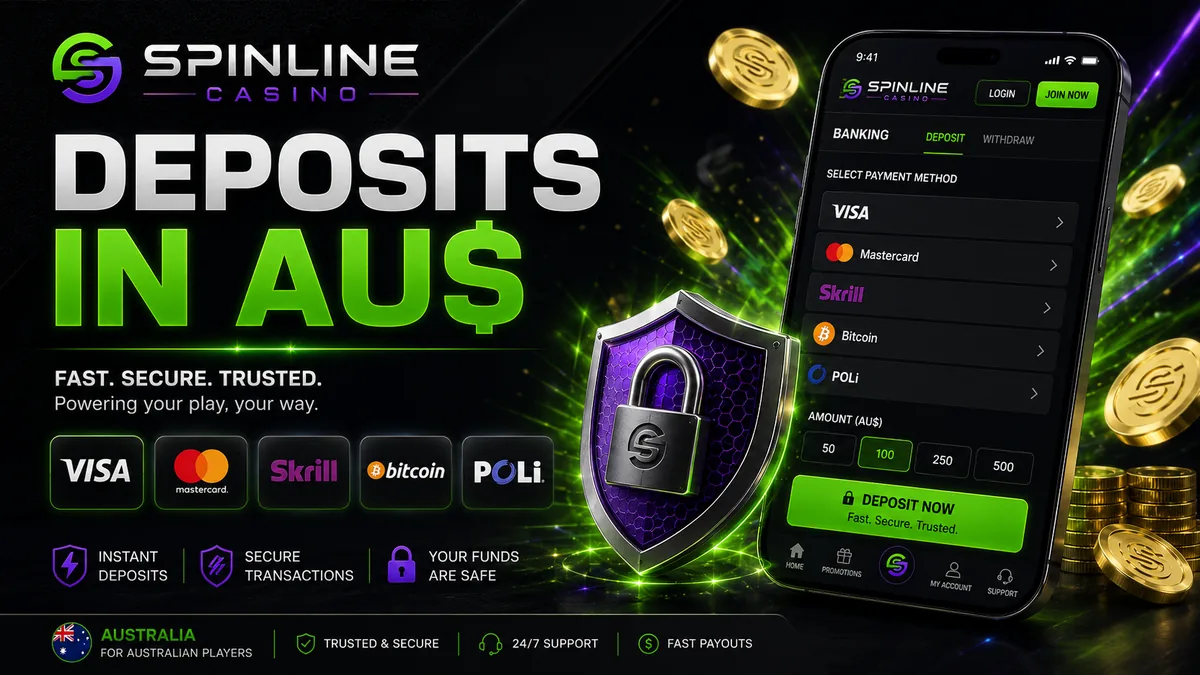
Deposit speed is the wrong thing to shop on, since almost everything in this cashier funds an account in seconds. What actually separates one method from another is whether it pays out as readily as it pays in, whether it clears the AU$30 minimum without fuss, and whether your bank will let a gambling transaction through in the first place.
Every Spinline payment method available to Australians
There are eleven methods across four categories. Cards, wallets and POLi all start at AU$30, and some promotional offers drop that to AU$25. Read the offer wording before you fund, because a deposit under the stated threshold will not trigger the bonus, and topping it up afterwards does not fix that. Crypto works off a coin threshold instead: 0.0005 BTC, or the equivalent in the other three.
| Method | Type | Minimum | Deposit speed | Also for withdrawals | Notes |
|---|---|---|---|---|---|
| Visa | Debit / credit card | AU$30 | Instant | Yes | Most common decline point for Australian banks |
| Mastercard | Debit / credit card | AU$30 | Instant | Yes | Same merchant-code issue as Visa |
| Skrill | E-wallet | AU$30 | Instant | Yes | Fastest fiat round trip in the cashier |
| Neteller | E-wallet | AU$30 | Instant | Yes | Same parent as Skrill, near-identical behaviour |
| MuchBetter | Mobile e-wallet | AU$30 | Instant | Yes | App-based, confirms by phone rather than password |
| Paysafe | Prepaid voucher | AU$30 | Instant | No — deposits only | You will need a second method to be paid out |
| POLi | Online bank transfer | AU$30 | Near-instant | No — deposits only | The one genuinely local option on the list |
| Bitcoin | Cryptocurrency | 0.0005 BTC | After network confirmations | Yes | Slowest confirmations of the four coins |
| Ethereum | Cryptocurrency | 0.0005 BTC equivalent | Minutes | Yes | Network fee swings sharply with congestion |
| Litecoin | Cryptocurrency | 0.0005 BTC equivalent | Minutes | Yes | Cheapest transfer fees of the four |
| USDT | Stablecoin | 0.0005 BTC equivalent | Minutes | Yes | No exchange-rate drift between deposit and play |
All of it checked against the operator’s published cashier on 3 September 2026. Providers come and go without notice, so if something above is missing when you log in, go by what the cashier shows and treat this page as behind the times.
Visa and Mastercard: the method most likely to fail
Cards are what most Australians reach for first, and they cause more support tickets than everything else in the cashier put together. A card payment that clears is instant. The catch is how often it doesn’t clear, usually for reasons that sit with your bank and not with Spinline.
Why Australian banks decline gambling card payments
Every card transaction carries a merchant category code, and gambling carries MCC 7995. Australian banks read that code and then apply whatever policy they have. Credit is the hard case, because lenders here are barred from letting gambling run on credit. Several of the major banks extend the same block to debit by default, with the opt-in toggle buried somewhere in the app. The code isn’t the whole story either. A payment to an offshore acquirer also scores badly on fraud checks, since the merchant is one your bank has never seen, the processor is foreign, and it is your first time using either.
All of that reaches you as a generic “declined by issuer” message. Spinline never received the money, so nothing is pending and nothing needs reversing. Resist hammering the same card six times in a row. Repeated declines push it up the bank’s risk model, and a card can end up frozen for card-not-present transactions altogether.
What to do when a card is refused
Start with the gambling block switch in your banking app. Then try debit rather than credit, since the credit restriction is written into law and no amount of arguing with the call centre will move it. If the bank still refuses, change rails: an e-wallet funded from the same account usually clears, because that top-up is not coded as gambling. One more thing, and it’s the kind that surfaces later rather than at the till. Register the card in the same name as your Spinline account. A mismatch sails through at deposit and then stops your first payout at verification, with the money already sitting there. Getting the details right during account setup avoids that entirely.
POLi and bank transfer: the only local rail in the cashier
POLi is the one method in the cashier built for this country. You select it, pick your bank, log into internet banking inside the POLi window and confirm a transfer that is already filled in with the amount and reference. The money leaves your everyday account and shows up in the casino balance within moments, without a card, a wallet registration or any third-party account to open first.
There are two catches. POLi only pushes one way: it carries money to the casino and has no mechanism for sending it back, which rules it out as a payout route, so a wallet or card needs to exist on your account before your first win lands. The second catch is the login step itself, since several Australian banks have spent years telling customers not to type internet banking credentials into a third-party window. If your bank is absent from POLi’s list, or the login simply fails, that is a decision made on the bank’s side, and an e-wallet is the easier route.
E-wallets: Skrill, Neteller, MuchBetter and Paysafe
Wallets work best for offshore play, and it comes down to where they sit in the chain. Your bank sees a top-up going to a licensed payments company, the casino sees an ordinary wallet payment, and the MCC 7995 problem never comes up.
Skrill and Neteller share a parent and behave almost identically. Deposits are instant, and their withdrawals are the quickest fiat option here because the money never has to cross a card scheme. For anyone moving funds in and out regularly, one of the two is the sensible default. MuchBetter takes a different shape: the account lives in an app, and payments confirm with a PIN or biometrics rather than typed card details, which makes it far less fiddly on a phone.
Paysafe comes with a warning, because it is a prepaid voucher rather than an account. You buy a code, spend it, and nothing is left over afterwards. That makes it a blunt but effective spending cap. It also means a payout has nowhere to land, since no Paysafe balance exists for the money to travel back to. Deposit by voucher and you still have to nominate another method for withdrawals, one that gets verified in your name before anything is released.
Fund your account and claim the welcome package
Cryptocurrency: Bitcoin, Ethereum, Litecoin and USDT
Four coins, with the floor at 0.0005 BTC or its equivalent. Crypto gives the fastest full circle at Spinline, and the reason is structural. No bank sits in the middle able to decline anything, and there is no scheme settlement window to wait out. The casino’s approval is the only gate, so a payout requested on a Sunday moves at the same pace as one on a Tuesday.
None of that speed is free, though. Every transfer carries a network fee that belongs to the blockchain, not to Spinline, and it comes out of what lands in your balance. On Ethereum the fee swings hardest with congestion and stings on a small deposit; Litecoin stays the cheapest of the four; Bitcoin is the slowest to credit, because the casino waits for confirmations before it releases anything. The other cost is the one people forget. Deposit in BTC and the balance converts at whatever rate applies the moment it credits, so a coin that drifts a couple of percent between send and confirmation leaves you with a figure that does not match your arithmetic. USDT is the way around that, which is why it suits anyone who wants crypto speed without watching a price chart on the side.
One thing here allows no slack: match the coin, the network and the address to exactly what the cashier tells you. Blockchain transfers cannot be recalled. Send Litecoin to a Bitcoin address, or push USDT over a network the cashier did not specify, and the money is gone, with no way for support to get it back.
What about PayID and Neosurf?
These two come up more than anything else, and they are where a lot of pages about Spinline are flatly wrong. PayID is the near-universal instant transfer rail in this country. Neosurf vouchers sit behind the counter at newsagents and service stations. Both turn up constantly on comparison lists, and several sites state outright that Spinline accepts them.
Going through the operator’s published cashier method by method on 3 September 2026, neither one showed up. Not behind a currency toggle, not under some other label. They might appear later, since providers rotate in and out, but that is a guess. What isn’t a guess is simpler: anyone telling you they work today has not actually checked, so do not open an account expecting a PayID field to be sitting there.
If one of those two really is your only option, POLi is the nearest substitute, because it also pulls straight from an Australian bank account without a card in the middle. For the operator’s own current position rather than a third party’s, ask live chat before you deposit; support runs around the clock. Better still, check any payment claim inside the cashier itself once you are logged in, since that is the only list the operator is bound by.
How long payouts actually take, by method
Deposit times land within seconds of each other right across the cashier, so they tell you nothing useful. Payouts are the ones spread over days, and that is where the real choice sits. Spinline quotes withdrawals as generally processed within 24 hours, and that figure covers only its own approval step; whatever the payment rail adds afterwards is separate.
Hours from request to funds leaving the casino.
Read each bar as approval plus transit. Crypto and wallets add almost nothing once approval is done. Cards add a scheme settlement window that no casino controls and that takes no notice of weekends. Paysafe and POLi never reach this stage at all, so a deposit made with either one sends your payout to whichever alternative you have verified. Whatever you pick, the first cash-out is the slow one, because verification happens around it. The sequence, the document list and the limits are set out on our withdrawal times page, which is better read in advance than in the middle of a pending request.
Currency, conversion and what you actually pay in fees
Pick AU$ as your account currency at registration. On the sign-up form it looks like a throwaway setting, and it is not one. An account held in another currency converts on every deposit and again on every withdrawal, a spread taken each time, and on platforms like this the currency generally cannot be switched later. With AU$ set, card, wallet and POLi deposits land at face value. Crypto stays the exception, since the coin converts at whatever rate applies when it credits, so timing shapes the balance as much as the amount you send. USDT is the only one of the four that gives you a number you can predict up front.
The fees you actually feel are rarely charged by the casino. There is the blockchain network fee, whatever your wallet provider takes, and the foreign-transaction fee your bank may apply to a card payment processed offshore. That last one is a term of your bank’s product and turns up on the statement rather than in the cashier, which is why it catches people out. Read the confirmation screen before you press send, since the figure on it is the amount leaving your account. Minimums interact with promotions as well: the deposit bonus tiers each carry their own qualifying amount, so a perfectly valid AU$30 deposit can still fall short of the tier you were aiming for. For the regulatory side of paying an offshore operator in Australian dollars, see AU$ payments and the law.
Deposit in AU$ and start playing
FAQ
What is the minimum deposit at Spinline for Australian players?
AU$30 on cards, e-wallets and POLi, with some promotional offers dropping it to AU$25. Crypto runs on a coin threshold instead: 0.0005 BTC or the equivalent. Deposit under whatever amount an offer specifies and it will not qualify, and topping up later does not rescue it.
Does Spinline accept PayID?
Not according to the operator’s published cashier as at 3 September 2026. PayID was not listed there, whatever several comparison sites claim. POLi is the closest local alternative, since it also draws straight from an Australian bank account.
Why did my Australian bank decline the deposit?
Almost always the gambling merchant category code. Credit cards cannot fund gambling in Australia, and several banks apply the same block to debit accounts by default. The money never reached the casino, so there is nothing sitting anywhere that needs reversing.
Can I withdraw to POLi or Paysafe?
No, both are deposit-only by design. Set up a card, e-wallet or crypto wallet in your own name for payouts, ideally while there is nothing waiting to be paid out.
Which method gets money out fastest?
Crypto, with e-wallets close behind, since neither depends on banking hours or scheme settlement. Cards are the slowest supported payout route, because the scheme adds a clearing window once the casino has already approved the request.
Are there fees on Spinline deposits?
The costs you will notice come from outside the cashier: blockchain network fees, your wallet provider’s charges, and any foreign-transaction fee your bank applies to an offshore card payment. Whatever the confirmation screen shows is the amount that will leave your account.